
An off-road electric buggy for a finca near Marbella should be chosen around the ground it will cover, not the appearance of its tyres. A country home with a firm driveway has different requirements from an estate with loose tracks, tight turns and repeated changes in gradient.
The Forester range gives buyers several passenger layouts to compare. This guide looks at how to assess that range for everyday movement around a property, what to check on a demonstration and when a different type of working vehicle may be more appropriate.
Map the ordinary journeys first
List the routes between the house, entrance, guest accommodation, garden and outbuildings. Include the narrow places where you turn, park or pass another vehicle. A successful route assessment covers the whole journey, including the return when the buggy is loaded.
Take photographs of drainage channels, steep transitions and rough areas. Assess how those areas change after rain, not only during a dry visit. Ground that is passable today may need repairs or a different route before a buggy can be used consistently.
Distinguish passenger transport from gardening and maintenance. Carrying two people with a few belongings is a different task from moving tools, cuttings or heavy materials around the same property.
Compare Forester layouts against the people travelling
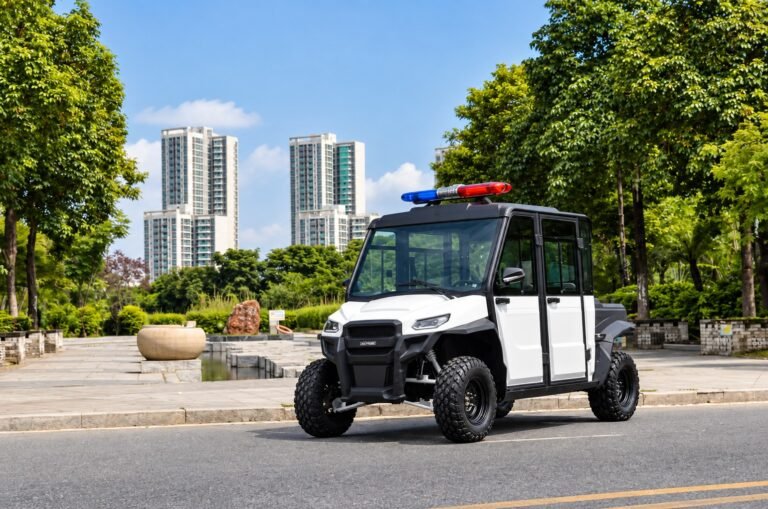
Le Forester 2, Forester 4 and Forester 6 are listed with different passenger capacities. Confirm the approved configuration, seating arrangement and load limits for the specific unit offered.
Choose for your usual journeys. A couple moving around a finca may not need the same layout as a family carrying guests. Equally, a longer vehicle needs space to manoeuvre and park; extra seats can introduce practical constraints at a narrow entrance.
During a viewing, sit in the positions that will actually be used. Check entry, foot space, restraints where fitted and the ability to communicate with the driver. Confirm how personal items will be secured.
Understand what off-road capability does and does not mean
Tyres, clearance and chassis layout all matter, but none makes every track suitable. Loose surfaces, ruts, wet ground and side slopes can change the task substantially. Ask for advice on the specific terrain rather than interpreting a catalogue gradient figure as permission to use any slope.
Do not assume four-wheel drive from the word Forester or from an off-road appearance. Confirm the drivetrain of the actual vehicle. Ask how load and surface conditions affect its operation and which routes should be avoided.
A sensible demonstration checks normal use within the manufacturer’s instructions. It should not involve testing a vehicle beyond its stated limits or trying to cross ground that has not been assessed.
Keep public-road access as a separate question
The Forester range is presented in our off-road category. Do not assume a particular Forester can use public roads or cross a public lane between two parts of a property.
If your intended journey leaves private land, explain that before selecting the vehicle. Ask for documentary confirmation of road approval and the registration, insurance and driver requirements for any proposed road-going alternative.
Similarly, an off-road vehicle does not provide permission to enter neighbouring land, public trails or protected areas. Ownership of the vehicle and permission to use a route are separate matters.
Decide whether you need passenger space or a load bed
For visiting family and everyday movement, a passenger Forester may be worth assessing. For regular tools, supplies or grounds work, a utility vehicle may fit the task better. Compare the load’s dimensions, weight and securing points before making the choice.
Include the Turfman 2000 in a working-vehicle discussion where appropriate. Its suitability still needs to be assessed for your route and configuration. A cargo-oriented design is not a reason to skip the terrain survey.
Never treat an unoccupied seat as a rated cargo platform or carry passengers on a load bed. Agree how each item and each person will travel safely.
Prepare charging and storage at the finca
Locate a suitable parking area near the intended electrical supply. Have the installation checked for the actual charger and conditions, and route cables clear of people and vehicles. Consider how the buggy will reach that position at the end of the day.
Ask for the maintenance schedule and cleaning instructions. Tyres, brakes, steering and electrical components still need inspection. Before the property is left vacant, follow the model-specific battery storage guidance and decide who will carry out any required checks.
Discuss the real route with our Marbella team
Bring your route photographs, passenger requirements and intended loads to Electric Buggy Company. Use our contact page to arrange a discussion in San Pedro de Alcántara, or request a model-specific quotation.
Frequently asked questions
Which Forester is best for a finca?
There is no single answer. Assess passengers, loads, turning space, surfaces and slopes before comparing the two-, four- and six-person layouts.
Does an off-road tyre make the vehicle suitable for steep ground?
No. Suitability depends on the complete vehicle, surface, load and operating limits. Have the route assessed and follow the manufacturer’s instructions.
Are all Forester models four-wheel drive?
Do not assume that from the range name. Confirm the drivetrain and supplied specification of the particular model before ordering.
Can I use a Forester on public roads?
Do not assume road approval. Ask for documentation for the exact variant, or discuss a suitable documented road-legal alternative.
Can it replace a maintenance vehicle?
Only if the load and route requirements fit. Where cargo is the main task, compare an appropriate utility configuration rather than relying on passenger space.

 French
 English
 Spanish
 German
 Portuguese