
Many households in Mallorca reach the same point sooner or later. One car is no longer enough, but a second car feels like too much: another vehicle to fuel, service, insure and, above all, park. More and more residents and villa owners are solving the problem differently, with a road-legal electric buggy.
In this article we compare the two options honestly, so you can decide which one fits the way you actually live on the island.
How People Really Use a Second Car in Mallorca
Before comparing costs, it helps to look at the journeys themselves. For most households, the second car does short, repetitive trips: to the bakery, the beach, the port, the golf club, the school or a neighbour’s house. Very few of those journeys are long, and most happen within a few kilometres of home.
That pattern is exactly where a road-legal electric buggy is strongest. It is designed for local roads and short distances, and it does them quietly, cleanly and cheaply.
Running Costs
Energy. A buggy charges from a normal socket at home. Charging costs far less than filling a petrol tank, especially if you charge overnight on a cheaper tariff or have solar panels at the villa.
Maintenance. An electric drivetrain has far fewer moving parts than a combustion engine. There are no oil changes, no exhaust, no clutch and no engine servicing. Maintenance is simple and infrequent.
Purchase. A road-legal buggy is generally a smaller investment than a new car, and the exact figure depends on the model, the seating and the options you choose.
Registration and insurance. A road-legal buggy is a registered vehicle, so it needs number plates, insurance and periodic technical inspection, just like a car. The difference is that everything else around it costs less to run.
Parking and Everyday Convenience
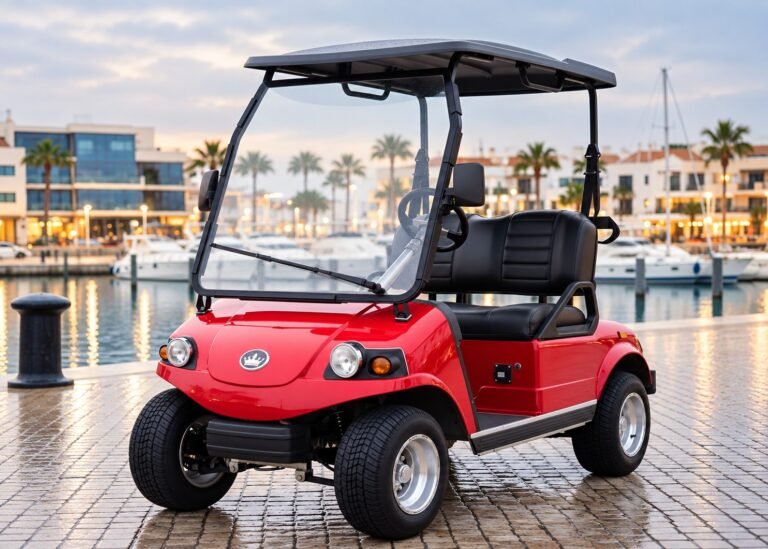
Anyone who has tried to park in Port d’Andratx, Puerto Portals or the centre of Palma in August knows how much time it can take. A compact buggy fits into spaces that a car cannot, and it makes short trips feel easy again. In village centres with narrow streets, such as Sóller, Deià or Pollença, a smaller vehicle is simply more practical.
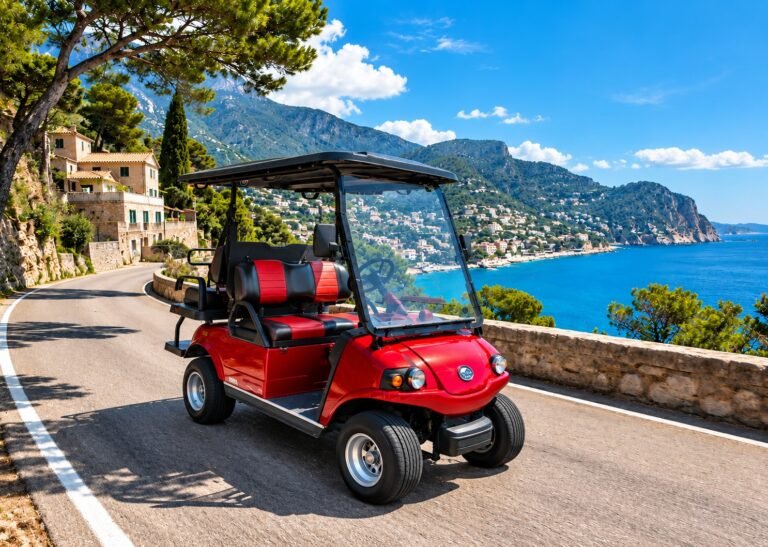
There is also the pleasure factor. Driving an open buggy along the coast in the evening is a completely different experience from sitting in traffic in a car.
Where a Car Is Still the Better Choice
A buggy is not a replacement for every journey, and we would rather be clear about that. It is designed for local roads, not motorways, so it is not the right vehicle for regular trips across the island, airport runs or long drives from Palma to the north. If those journeys make up most of your driving, your main car should handle them.
The strongest combination for most households is one car for longer trips and one road-legal buggy for everything local.
Which Buggy Makes Sense as a Second Vehicle?
For a couple, a two-seat road-legal model covers daily errands comfortably. For families, the Classic 4 EEC gives room for everyone. If your property includes land, tracks or steep access, a more capable model may suit you better. You can compare our main ranges or explore all our road-legal models.
A Simple Checklist
Ask yourself these questions:
- Are most of my second-car journeys under a few kilometres?
- Is parking a regular problem where I go?
- Do I have somewhere at home to charge overnight?
- Do I mostly carry one passenger, or a full family?
If you answered yes to the first three, a road-legal electric buggy is very likely the smarter choice.
Try It for Yourself in Palma
At our Mallorca showroom you can compare models, ask about registration and insurance, and take a test drive on real roads.
Electric Buggy Company Mallorca
Carrer Setze de Juliol, 6, Palma
Tel: +34 648 518 731
electricbuggycompany.com
Contact our team to arrange a visit.
Frequently Asked Questions
Can an electric buggy replace a second car in Mallorca? For short local journeys, yes. A road-legal buggy handles daily errands, beach trips and visits to the club. For motorway driving and long trips, a car remains the better option.
Is a buggy cheaper to run than a car? Generally yes. Charging costs less than fuel, and maintenance is much simpler because there is no engine to service.
Does a road-legal buggy need insurance and inspection? Yes. As a registered vehicle it needs number plates, insurance and periodic technical inspection.
Can I drive a buggy on the motorway? No. Road-legal buggies are designed for local roads, not motorways.
Where can I charge it? At home, from a standard socket, usually overnight.
====================================================================


 English
 Spanish
 German
 French
 Portuguese